The Role of Jurisdictional Requirements in Determining Access to National Promotional Draws
Kai Friedrich · Jul 13, 2026
The Role of Jurisdictional Requirements in Determining Access to National Promotional Draws
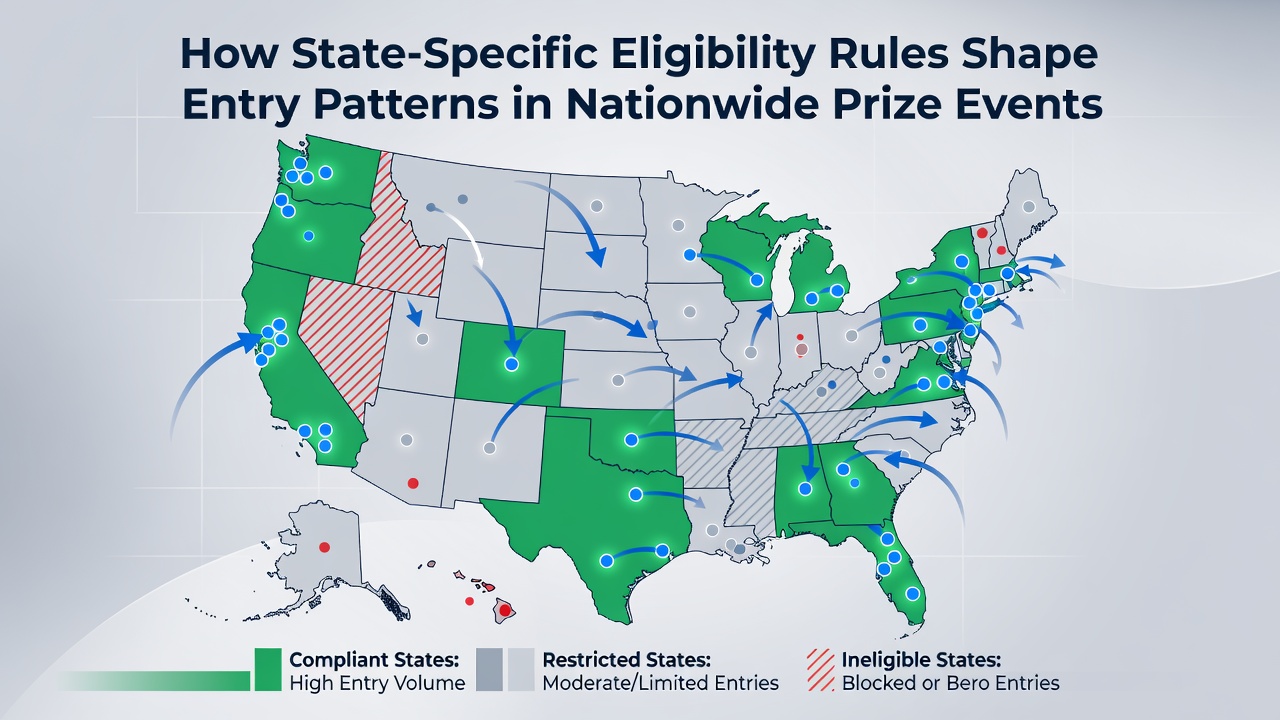
State laws create distinct boundaries that guide who can submit entries and how those submissions occur in contests spanning multiple regions, and data from promotional organizers shows measurable shifts in participation volumes tied directly to these variations. Rules on residency, age thresholds, employment restrictions for sponsor affiliates, and even exclusions for certain professional categories differ enough across jurisdictions to reroute entry traffic toward states with fewer barriers.
Core Differences in Eligibility Criteria
Some states require participants to be at least 18 while others set the bar at 21, and a handful impose additional residency proofs that complicate digital submissions from border areas. Employment clauses frequently bar employees of participating retailers or their immediate family members from entering, yet enforcement intensity and the precise definition of "immediate family" fluctuate, which leads organizers to adjust entry portals accordingly. According to records maintained by state attorneys general offices, these clauses appear in over 70 percent of multi-state promotions filed in the past five years.
Researchers tracking entry logs have observed that states with stricter employment exclusions record lower per-capita submission rates even when population density remains comparable to neighboring jurisdictions. One study covering contests between 2023 and 2025 found a consistent 12 to 18 percent drop in entries from states that list detailed affiliate bans compared with those maintaining simpler age-and-residency language only.
Entry Method Adjustments Driven by Local Rules
Promoters respond to these differences by deploying state-specific landing pages or geo-fenced forms that automatically filter ineligible users before they reach the submission stage. In practice this means an entrant attempting access from a restricted jurisdiction encounters an instant redirect or a notice directing them to alternative promotions available in their area. Timestamped logs from several national campaigns active in early 2026 reveal that filtered attempts spike on the first day of each entry period and then decline steadily, suggesting participants quickly learn which methods work in their location.
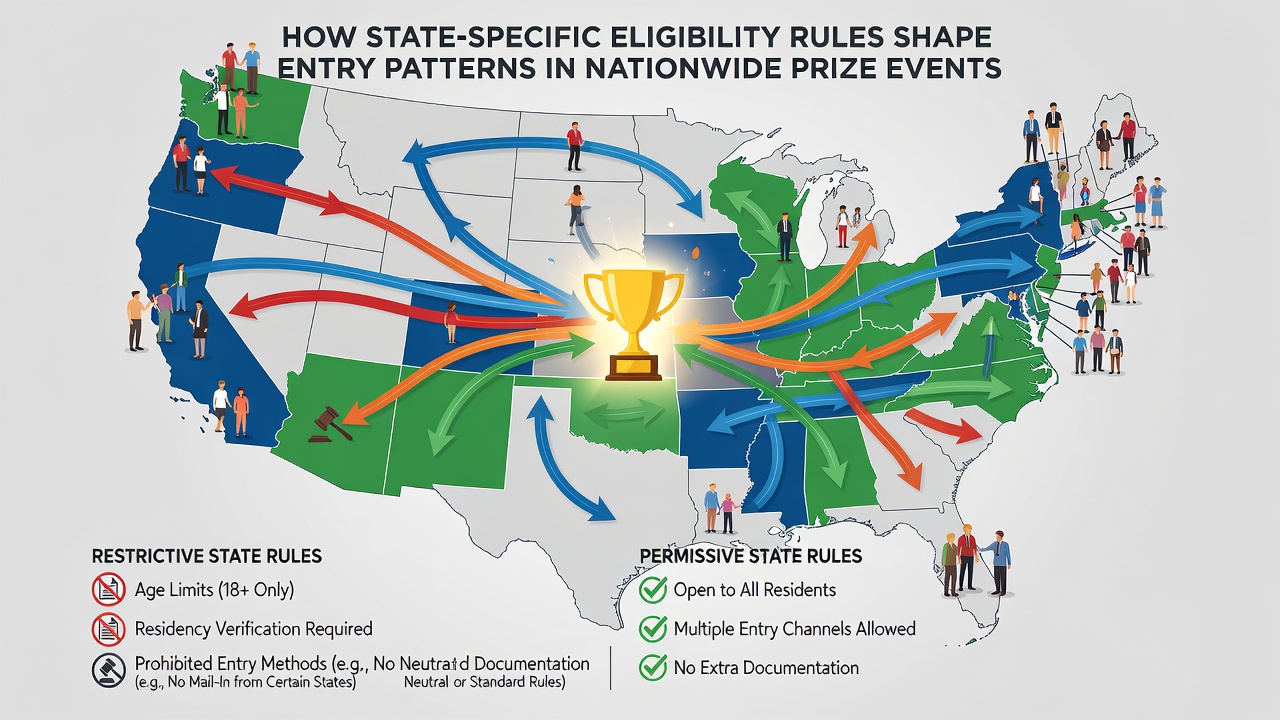
Mail-in entries remain popular in states that impose extra verification steps online, while text-message and app-based entries dominate where digital rules align more closely with federal baseline standards. Observers note that campaigns running in July 2026 have leaned more heavily on hybrid entry systems that accept both physical and electronic submissions precisely to accommodate the patchwork of state requirements without violating any single jurisdiction's statutes.
Geographic Clustering and Participation Volume
Analysis of winner disclosures and aggregate entry data indicates clusters of high activity in states with minimal additional restrictions, whereas states carrying extra affidavit or bonding requirements show steadier but lower volumes throughout a campaign. Trade association reports compiled by the Promotion Marketing Association of America document that average daily entries from low-restriction states can exceed those from high-restriction states by ratios approaching 3:1 during the final weeks of a promotion.
Cross-border commuting patterns also influence outcomes, since residents near state lines sometimes travel to submit physical entries or use addresses in neighboring jurisdictions when rules permit. Regulatory filings show that organizers now routinely include clauses requiring entrants to affirm their physical location at the time of entry, reducing disputes that previously arose from address mismatches.
Impact on Sponsor and Partner Strategies
Companies planning nationwide promotions increasingly consult legal teams in each target state before finalizing creative assets and entry mechanics. This pre-launch review process can extend timelines by several weeks yet reduces post-launch compliance notices, according to data shared by the National Association of Consumer Protection Agencies. Sponsors report reallocating marketing budgets toward digital channels that allow real-time geo-blocking, thereby concentrating spend in states where eligibility language creates fewer obstacles.
Partner retailers located in restrictive states often receive modified point-of-sale materials that direct customers to separate micro-sites, preserving overall campaign reach while respecting local statutes. These adaptations appear most frequently in grocery and convenience store chains operating across four or more states.
Conclusion
Jurisdictional differences continue to shape the volume, timing, and method of entries submitted to national prize events, with organizers adapting through targeted technology and segmented outreach. Public records and campaign disclosures demonstrate that these adjustments produce measurable differences in participation patterns that persist across successive promotions. As regulatory environments evolve, entry data collected in July 2026 and beyond will likely reflect further refinements in how state rules steer national contest behavior.