Maintaining Integrity in Recurring National Giveaways via Cross-Referencing Entry Records and Partner Data
Taylor Hughes · Jun 17, 2026
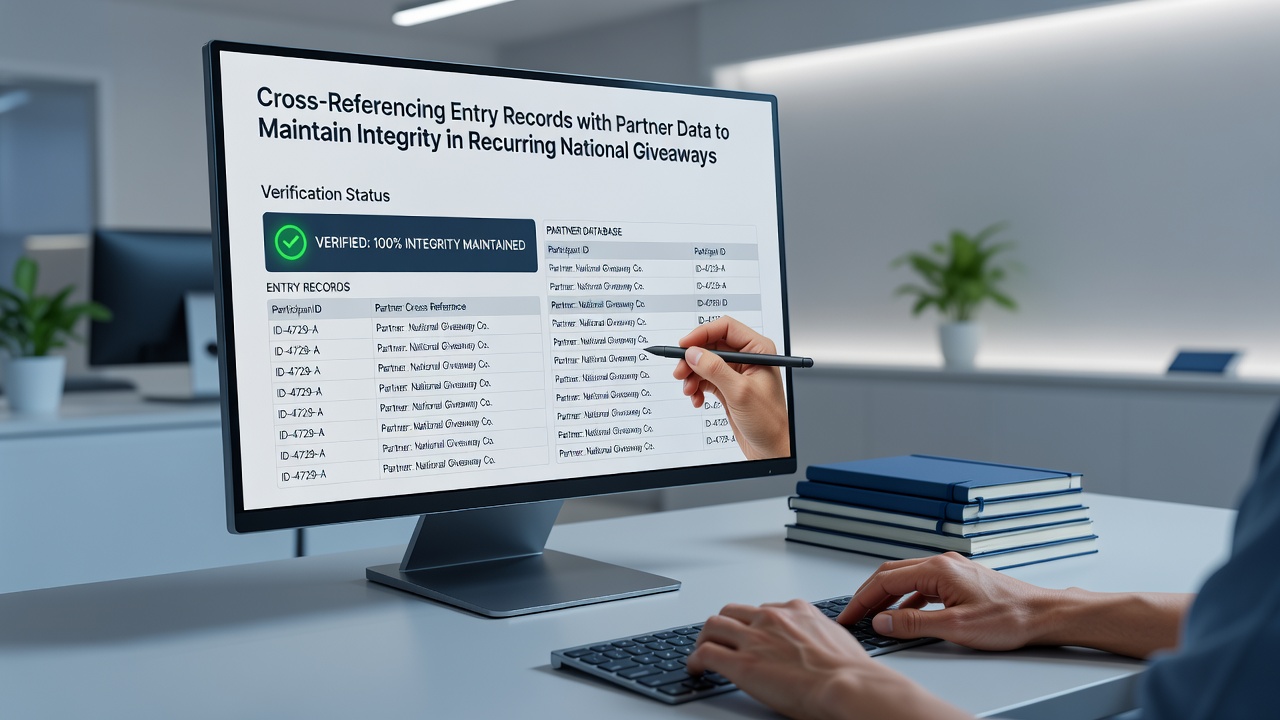
Maintaining Integrity in Recurring National Giveaways via Cross-Referencing Entry Records and Partner Data
National giveaways that repeat across multiple months or years depend on accurate record-keeping to prevent duplicate entries and ineligible claims, and cross-referencing entry records with partner data forms a core part of that process. Organizers collect participant details from various channels including online forms, retail receipts, and social media actions then match those details against information supplied by partner companies such as retailers or service providers. This matching occurs through automated scripts that flag inconsistencies in names, addresses, email domains, or device identifiers before selections take place.
Systems built for recurring events store historical entry data in secure databases that update daily, allowing administrators to compare new submissions against prior records from the same promotion cycle or earlier ones. When a partner contributes additional data such as purchase confirmations or membership status, the cross-reference step verifies whether an entrant meets eligibility criteria tied to that partner offer. Discrepancies trigger manual review queues where staff examine supporting documents before approving or rejecting the entry.
Data Matching Protocols in Multi-Partner Environments
Protocols typically combine deterministic matching on exact fields like government-issued ID numbers with probabilistic scoring on elements such as phone numbers or IP addresses that may vary slightly across submissions. Partners transmit encrypted batches of qualifying customer records at set intervals, and these batches integrate into the central entry system through APIs that log every transfer for audit trails. In June 2026 several large-scale campaigns plan to adopt enhanced hashing standards recommended by international data-protection frameworks, which will further reduce the chance of false matches while preserving participant privacy.
One documented workflow involves nightly reconciliation jobs that align timestamped entries with partner redemption logs, producing exception reports listing any unmatched or suspicious activity. These reports feed into dashboards used by compliance teams who adjust selection algorithms if patterns suggest systematic issues such as coordinated entries from shared devices. The process keeps selection pools clean without delaying prize draws that occur on fixed schedules.
Regulatory Expectations and Audit Practices
Regulatory bodies in multiple jurisdictions require documented evidence that entry integrity measures remain active throughout a promotion period. The Federal Trade Commission outlines basic standards for record retention and verification in its guidance on promotional contests, while the Australian Competition and Consumer Commission issues parallel expectations for transparency in recurring prize events. Auditors examine sample cross-reference outputs during post-event reviews to confirm that partner data contributed to accurate disqualification decisions rather than serving only as marketing collateral.

Independent testing laboratories sometimes receive anonymized data sets to simulate selection runs and measure whether cross-referencing altered finalist pools in statistically meaningful ways. Findings from these simulations help organizers refine matching thresholds ahead of subsequent cycles, ensuring continued compliance without unnecessary exclusion of legitimate participants.
Technical Infrastructure Supporting Ongoing Verification
Cloud-based platforms host the majority of modern cross-referencing operations because they scale easily when entry volumes spike during peak promotion windows. Encryption at rest and in transit protects both entrant information and partner datasets, while role-based access controls limit which staff members can view raw matched records. Logging every query and update creates an immutable chain that regulators or courts can examine if disputes arise after winners receive prizes.
Integration layers translate partner file formats into standardized schemas so that address variations or loyalty-tier codes map consistently across sources. When a national campaign spans several countries, these layers also accommodate differing data-protection rules by applying jurisdiction-specific filters before any matching occurs. The result is a unified view of entry eligibility that still respects local legal boundaries.
Impact on Selection Equity Across Repeated Draws
Consistent application of cross-referencing rules contributes to equitable outcomes because each recurring draw draws from a pool that has already undergone the same integrity checks. Observers tracking long-running campaigns note that disqualification rates tied to partner data mismatches tend to stabilize after the first two or three cycles once participants learn the verification requirements. This stabilization reduces administrative burden and keeps public confidence higher than would occur with ad-hoc checks.
Reports filed with oversight agencies after major events frequently cite cross-referencing success metrics such as percentage of entries cleared automatically versus those escalated for review. These figures demonstrate that the method scales effectively for promotions attracting millions of entries while maintaining documented fairness standards demanded by both regulators and participating partners.
Conclusion
Cross-referencing entry records with partner data supplies the factual backbone for integrity in recurring national giveaways by catching inconsistencies early and producing auditable trails that satisfy regulatory scrutiny. As campaigns evolve through 2026 and beyond, the same core techniques continue to adapt through improved encryption, standardized APIs, and jurisdiction-aware filters, ensuring that repeated prize events rest on verifiable participant eligibility rather than assumptions.